Biography
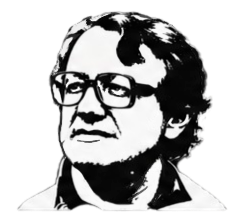
Ales Adamovich
Writer, publicist, literary scholar, screenwriter, and public figure.
Ales Adamovich belongs to those authors for whom literature was not only an art, but also a form of responsibility. He wrote about war, memory, human dignity, and the danger of oblivion.
1926–1940
Childhood and Hlusha
Family, early years, and the place that became Adamovich’s true home ground.
- #family
- #Hlusha
- #childhood
Ales Adamovich was born into a family of employees on September 3, 1927, according to his official documents. His actual birth date was August 3, 1926: during the war, his mother altered the date on his school certificate to protect him from being deported to Germany.
He was born in the village of Kaniukhy, Kapyl District, Minsk Region. “The most mysterious, legendary place in my biography is Kaniukhy itself, where I was born... I remember nothing of life there...”
His father, Mikhail Iosifovich Adamovich (1902–1948), came from the village of Rachen in Slutsk District. He studied medicine and worked at the Kapyl holiday home during university vacations. After graduating from the medical faculty of Belarusian State University, which he entered in 1923, he was assigned to permanent work in Hlusha, Babruisk District, Mahiliou Region, in 1928.
He moved to Hlusha with his wife Hanna Mitrafanauna (1904–1979), from the village of Zabalotstse in Liuban District, who graduated from the Mahiliou School of Pharmacy in 1935–1936, and their sons: Yauhen (1924–1992), who would become a doctor, and Aliaksandr. “My true home ground, where I came of age and entered life, was the workers’ settlement of Hlusha. The Soviet clarification: the Comintern glassworks.”
In 1930, Ales Adamovich’s grandfather, Mitrafan Famich Tychyna, was dispossessed and exiled with his wife and three of their seven children to distant, cold Yakutia. The authorities repeatedly reminded Adamovich’s mother that she was the “daughter of a kulak.” His grandfather remained forever in Yakut soil; the other family members returned to Belarus. These events echoed through many of Adamovich’s works.
In Hlusha, the future writer attended school from the first through the seventh grade. He loved books, especially Alexander Pushkin, and reread Leo Tolstoy’s War and Peace many times. His strongest male role models were his father and his uncle Anton, his mother’s brother and a mathematics teacher.
Mikhail Iosifovich Adamovich secured the construction of a hospital in Hlusha and became its director. In Ales Adamovich’s words, the “radius of authority of a rural doctor” deservedly extended beyond the settlement to the entire surrounding area. From January 1940, his father served in the military. He was at the front from the first days of the war, worked as a physician with the 13th Army under Nikolai Pukhov, and rose to the rank of lieutenant colonel in the medical service.
1941–1945
War. Partisans
Partisan experience and the first encounter with what would become the central theme of his work.
- #war
- #partisans
- #memory
In 1940–1941, Ales studied in Biarozki in the Khocim region of Mahiliou Province, where his uncle Anton worked as a teacher and helped shape his character and knowledge. He returned to Hlusha on the day the war with Germany began: for his mother, his elder brother Yauhen, and himself, it became a war under their own roofs.
From September 1941, Hanna Mitrafanauna became an active participant in the Hlusha underground. As head of the local pharmacy, she brought medicines from Babruisk and supplied the Kirov partisan unit, while she and her children carried out different assignments.
In early 1943, she and her sons went into the forest and joined the Kirov partisan unit of the 37th Parkhomenka Brigade of the Minsk formation. When Ales left for the partisans, he replaced the loaf of bread his mother had put in his bag with a one-volume edition of Pushkin.
For some time he did household work in the camp; later he took part in battles in the Babruisk and Akciabrsk districts and saw death face to face. At the end of 1943, part of the unit joined the Soviet Army and crossed the front line.
In early 1944, by assignment of the Central Headquarters of the Partisan Movement, Ales was sent to Leninogorsk in Altai, where his aunt was living in evacuation. There he studied at the Leninogorsk Mining and Metallurgical Technical School and worked at the same time. He met Victory Day in Leninogorsk.
1946–1959
Literature and Scholarship
Studies, philology, literary criticism, and the beginning of his research path.
- #BSU
- #criticism
- #literary studies
Returning to Hlusha in 1945, he passed his secondary-school exams externally and entered the philology faculty of Belarusian State University. After graduating in 1950, he continued as a postgraduate student and completed that course in 1953.
In 1948, he began writing the novel Sons Go to Battle. On November 25, his father died unexpectedly. Mikhail Iosifovich had gone by truck to help a woman in labor; when the truck broke down, he walked through a night snowstorm, returned home with a high fever, and suffered a stroke. His father’s death deeply shook Ales.
In 1950, Adamovich appeared in print as a critic. He wrote about the novel as a genre, creative style, and artistic individuality. From his first publications, his combative temperament, wide perspective, sensitivity to truth, and resistance to vulgar sociological formulas were already visible.
In 1954, after defending his dissertation on the language of Kuzma Chorny’s novel The Third Generation and the writer’s individual artistic style, he became a lecturer in Belarusian literature at BSU and later joined the Yanka Kupala Institute of Literature of the Academy of Sciences of the BSSR.
He wrote on the questions he considered urgent for Belarusian literature: the formation of genre, Kuzma Chorny and Fyodor Dostoevsky, Maksim Haretski and the classical tradition, war prose and village prose. His scholarly works drew broad public response and were translated into Russian.
In spring 1954, his daughter Natallia was born. His wife, Vera Siamionauna Adamovich, nee Medvedeva, was a philologist.
In 1958, his first book of literary studies, The Path to Mastery: The Formation of Kuzma Chorny’s Artistic Style, was published. In 1959, the collection of literary-critical essays The Culture of Creativity appeared.
1960–1966
Novels. Moscow. Return
A move toward prose where personal memory and documentary truth become central.
- #novel
- #cinema
- #dissidents
In 1960, the journal Druzhba narodov published the novel War Under the Roofs.
In 1961, his monograph The Belarusian Novel was published; it became the basis of his doctoral dissertation. He defended it in 1962 in Kyiv, at the T. G. Shevchenko Institute of Literature, after influential writers in Minsk threatened to block the defense.
In 1963, Druzhba narodov published the second part of the dilogy, Sons Go to Battle. These works later became the basis for Viktor Turov’s two-part film War Under the Roofs and Sons Go to Battle.
From December 1962 to 1964, Adamovich studied at the Higher Courses for Scriptwriters in Moscow. At the same time, he taught Belarusian literature at Moscow State University.
In 1966, he was forced to leave Moscow State University after refusing to sign a letter condemning Andrei Sinyavsky and Yuli Daniel. After returning to Minsk, he spent more than half a year unemployed before, with Andrei Makayonak’s support, joining the Yanka Kupala Institute of Literature as a senior researcher.
During the same period, he actively took part in the reform-minded Fifth Congress of Belarusian Writers, where the sixties generation clashed sharply with neo-Stalinists. In 1966, he published the novella Victoria, later titled Asiya.
1968–1981
Khatyn. Fiery Villages. Blockade
The film script Khatyn, 5 Kilometers, The Khatyn Story, I Am from the Fiery Village, work on The Blockade Book, and the novel The Punishmenters.
- #Khatyn
- #testimony
- #blockade
In 1968, Adamovich wrote the script for the documentary film Khatyn, 5 Kilometers, directed by I. Kolovsky. It marked a new stage in his approach to the war theme: tragedy replaced heroic simplification.
In 1969, Druzhba narodov published the novella The Last Vacation. At the same time, he published a series of essays, The Breadth of a Writer’s World, on Kuzma Chorny in the context of world literature.
In 1970, Adamovich finished The Khatyn Story. Although the work received positive responses, he felt he had shown only a tiny speck of truth, while the bottomless ocean of people’s fiery Khatyn memory remained unheard and unseen by the world. This led to the idea of a documentary book.
In 1970–1973, together with Yanka Bryl and Uladzimir Kalesnik, he traveled across Belarus with a tape recorder, visited hundreds of burned villages, and recorded more than three hundred witnesses of the wartime tragedy. These accounts formed the basis of I Am from the Fiery Village.
In 1975, I Am from the Fiery Village appeared as a separate edition, was translated into many foreign languages, and became a literary bestseller in the West. In Polymia, Adamovich published essays on Maksim Haretski titled Opening the Gate of My Treasury.
In 1977, the play Return to Khatyn was staged based on The Khatyn Story. Based on I Am from the Fiery Village, Viktor Dashuk filmed the documentary cycle Women from the Fiery Village from Adamovich’s script.
From April 1975, Adamovich began recording survivors of the Siege of Leningrad together with Daniil Granin. In 1979, the first part of The Blockade Book was published. In 1977, a two-volume collection of his works appeared.
On May 22, 1979, Adamovich’s mother died after a severe illness. In 1981, he published the novel The Punishmenters and continued developing a new view of war literature in books on contemporary war prose and the village at war.
1982–1985
UN. Antiwar Voice. Come and See
International speeches, antiwar conferences, and work on the film Come and See.
- #UN
- #antiwar voice
- #cinema
In 1982, Adamovich took part in the work of the UN General Assembly in New York as a member of the Belarusian delegation. During these years he traveled widely, took part in international antiwar and anti-nuclear conferences, gave reports, and gave many interviews.
His journalism from this period was later collected in the books Choose Life! and Literature and the Problems of the Century, both published in 1986, and Think It Through to the End, published in 1988.
In 1981–1983, a four-volume collected works edition was published.
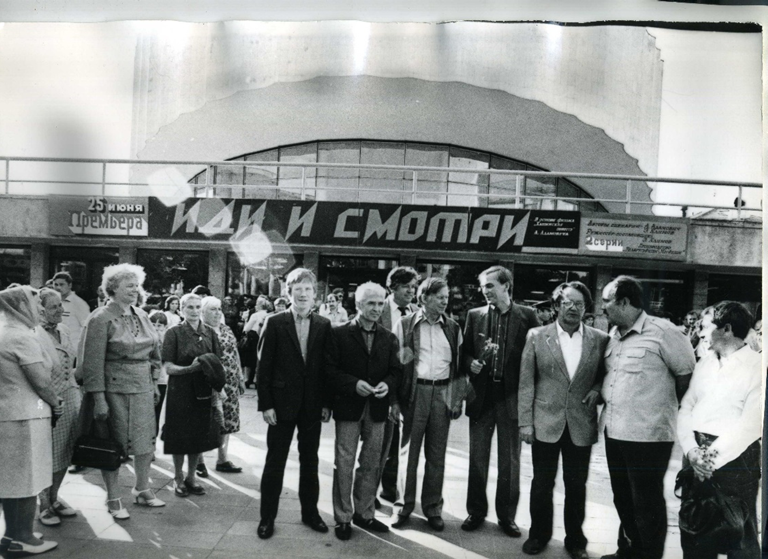
In 1984, the film Come and See, based on a screenplay by Adamovich and Elem Klimov, was shot in Belarus. The script drew on The Khatyn Story and The Punishmenters. Adamovich actively participated in the work and was present on set.
The film’s original title was Kill Hitler! Adamovich and Klimov had tried to make it for almost seven years: in 1977, work on the film had been stopped by Goskino.
In 1985, Come and See received the first prize, the Golden Prize, and the FIPRESCI Prize at the 14th Moscow International Film Festival, reached screens in many countries, and caused a major response.
1986–1994
Chernobyl. Perestroika. Final Years
Chernobyl, the public struggle for truth, parliamentary work, and the final return to Hlusha.
- #Chernobyl
- #perestroika
- #glasnost
In 1986, on the night when the reactor at the Chernobyl nuclear power plant exploded, Adamovich was flying south to the Caucasus, to the Zheleznovodsk sanatorium. He began looking for ways to break the wall of secrecy around Chernobyl and spoke with physicists and doctors in Minsk and Moscow about the possible consequences of the disaster.
After that he wrote to Mikhail Gorbachev, trying to convey to him and to the wider world the real scale of the catastrophe that had struck Belarus. Instead of using his intellectual authority, the Belarusian party leadership organized a campaign against him in the press, accusing him of pacifism, panic-mongering, and blasphemy.
As a result, Adamovich was forced to leave Minsk and move to Moscow, where in autumn 1987 he was elected director of the All-Union Research Institute of Cinema Art. During this period he completed the anti-utopian novella The Last Pastoral, chaired the short-film jury at the 15th Moscow International Film Festival, and published the book of stories and essays Prayer for the Future.
In 1988 he was able to publish “The Double,” a chapter of the novel The Punishers on which he had worked for several years.
In 1989 he became a people’s deputy of the USSR and actively used the congress platform to speak for perestroika, democratization, and glasnost. His late journalism was collected in the books We Won It Back! and We Are the Sixtiers.
During the August 1991 coup in Moscow, Adamovich stood among the defenders of the White House. He later reflected on those events in the publicistic memoir essay Thank You, Junta!
On December 21, 1991, he suffered a severe myocardial infarction. In 1992, while in a clinic and then in a sanatorium near Moscow, he hurried to complete his creative plans, including the novellas Venus, or How I Was a Serf and Nemko. In 1993 he published the essay Self-Treatment from Communism and the autobiographical novella Vixi.
In January 1994 he came to Minsk, took part in the work of the BPF Sejm, gathered relatives and close friends at home, traveled to Hlusha, and visited the graves of his brother and parents. On January 26, after speaking at the Supreme Court of the Russian Federation, he suffered a second and fatal heart attack.
Civil memorial services were held at the House of Cinema in Moscow and at the House of Writers in Minsk. He was buried in Hlusha on January 30, 1994, beside his brother and not far from the graves of his parents and grandmother.